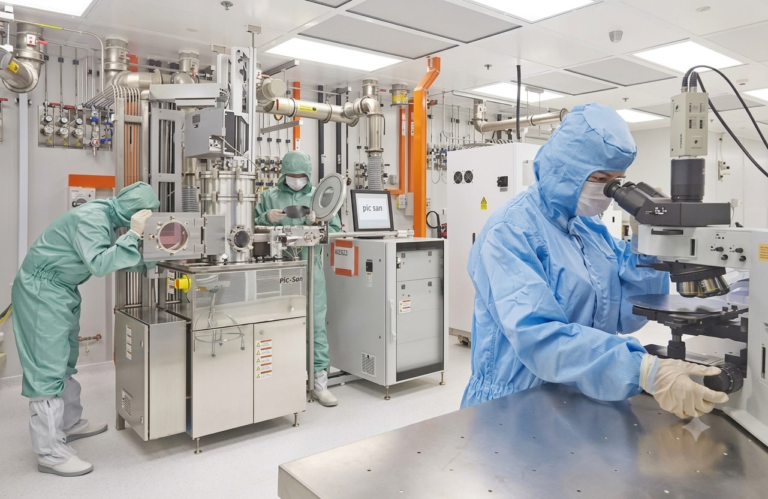
Labs and R&D Centres
Laboratory Design & Construction is a highly specialized area and needs thorough understanding of specific requirements, functional adjacencies, and risks involved. Types of laboratories are diverse starting from Basic Demonstrative Labs in schools to Advanced R&D Centres in renowned Universities and Corporates.
Spectrum has designed and executed several small to large-scale Laboratory projects for Life Sciences, Chemicals, Pharma, Biopharma, Food, Beverage, and Cosmetics Industry and are market leaders in this segment. Our experts can help you with:

Layout planning and Design

Laboratory Furniture and Fume Hoods

Lab Ventilation and Exhaust System

Utilities Generation & Distribution

High Purity Gas System

HVAC, Electrical & Fire Protection System

Handling & Storage Systems for Flammable and Toxic Chemicals

Explosion Proofing

Laboratory Waste & Effluent Deactivation and Treatment Systems
Expertise across Sectors and Types of Labs
Introduction to Labs and R&D Centres
In today’s rapidly evolving technological and scientific landscape, Labs and R&D Centres play a critical role in fostering innovation, enhancing product development, and sustaining competitive advantage. Whether in pharmaceuticals, biotech, engineering, or IT, organizations depend on robust research infrastructure to develop new products, improve existing processes, and maintain regulatory compliance.
In this blog post, we delve into the strategic importance of Labs and R&D Centres, their design considerations, operational best practices, and how investing in well-equipped research environments can yield long-term business success.
Why Labs and R&D Centres Matter
Labs and R&D Centres serve as the intellectual and technological backbone of modern industries. From ideation to prototype, and from testing to full-scale production, these facilities support the entire innovation lifecycle. Their key roles include:
Developing cutting-edge technologies
Enhancing product safety and efficacy
Reducing time to market through accelerated innovation cycles
Meeting global compliance and quality standards
Enabling interdisciplinary collaboration and knowledge transfer
Organizations with advanced R&D capabilities are better positioned to anticipate market needs, adapt to regulatory changes, and lead their industries.
Strategic Planning for Labs and R&D Centres
1. Site Selection and Location
When setting up Labs and R&D Centres, strategic location matters. Factors to consider include:
Proximity to academic institutions or industrial clusters
Access to a skilled talent pool
Infrastructure availability (power, water, connectivity)
Safety and environmental impact assessments
Local regulatory support and tax incentives
Choosing the right location can enhance collaboration, reduce operating costs, and facilitate recruitment of top researchers.
2. Facility Design and Space Planning
A well-designed research lab should be modular, scalable, and compliant with international safety norms. Key design elements include:
Flexible layouts to accommodate evolving research needs
Ventilation and HVAC systems for chemical and biological safety
Cleanroom environments for pharma and electronics R&D
Collaborative zones for team-based innovation
Data centers and smart infrastructure for digital R&D labs
Investing in professional office space planning and commercial interior design ensures functionality, safety, and compliance.
Designing for Innovation: Modern Trends in R&D Facilities
1. Modern Office Design in R&D
Many R&D centres now blend modern office design with scientific rigor. This includes:
Open-plan workstations adjacent to lab benches
Ergonomic design and natural lighting
Innovation zones and idea lounges
Collaborative digital whiteboards and project screens
These elements promote a culture of openness and creativity.
2. Flexible Office Solutions
R&D operations often need to scale quickly. Flexible office solutions enable rapid adaptation through:
Modular furniture and movable walls
On-demand lab benches and shared instruments
Coworking-style research zones
Short-term rental spaces for startup collaboration
This flexibility supports dynamic research demands and interdisciplinary workflows.
Regulatory Considerations in Labs and R&D Centres
R&D facilities, particularly in life sciences and pharmaceuticals, must comply with rigorous standards. These include:
Good Laboratory Practices (GLP)
Good Manufacturing Practices (GMP)
ISO certifications for quality and safety
Environmental Health and Safety (EHS) regulations
Integrating pharmaceutical validation services, equipment qualification, and process validation into lab operations ensures full compliance.
Digital Transformation in R&D Facilities
Smart Labs and Digital Twin Technology
Labs and R&D Centres are undergoing digital transformation. Innovations include:
IoT-based sensor monitoring
Cloud-connected lab instruments
AI-driven experiment optimization
Digital twin simulations for process modeling
These technologies not only improve efficiency but also create valuable digital records for future research and audits.
Data Security and IT Infrastructure
Protecting intellectual property is paramount. Advanced R&D centres invest in:
Encrypted storage systems
Access control for lab data
Cybersecurity training for researchers
Backup and disaster recovery protocols
Secure IT infrastructure is a cornerstone of any modern lab environment.
Sustainable R&D Facilities: A Growing Priority
As ESG goals take center stage, many companies are shifting toward sustainable building design in their R&D infrastructure. Key initiatives include:
Solar energy and green HVAC systems
Rainwater harvesting and waste recycling
LEED or BREEAM-certified designs
Sustainable material usage and supply chain management
Labs and R&D Centres designed with sustainability in mind reduce environmental impact while lowering operating costs.
Outsourcing and Collaboration Models
Not all companies build internal R&D capacity. Strategic options include:
Partnering with academic institutions
Co-locating in industrial innovation parks
Leveraging third-party turnkey lab solutions
Contracting engineering consulting services for facility setup
These models offer cost efficiency and access to specialized expertise.
Commercial Office Interiors in R&D Facilities
Office spaces within R&D centres must support both administrative and technical roles. Commercial office interiors are evolving to accommodate:
Lab managers and compliance officers
Project coordinators and finance teams
Visiting scientists and external auditors
Hybrid and remote work infrastructure
Blending science and management under one roof improves communication and project delivery.
Workforce Development and Training
The success of Labs and R&D Centres depends heavily on people. Companies must invest in:
Corporate training for lab safety and SOPs
Workforce development in digital tools and AI
Skill development in experimental design and analytics
Professional development for leadership in R&D
Regular training ensures that talent keeps pace with technological advancements.
Challenges Faced by R&D Facilities
Despite their benefits, Labs and R&D Centres face several challenges:
High capital expenditure
Talent retention and recruitment
Managing regulatory risk
Coordinating global research teams
Ensuring data reproducibility and validation
Overcoming these challenges requires a strategic approach to design, staffing, compliance, and technology adoption.
Future of Labs and R&D Centres
The future of Labs and R&D Centres is driven by:
Automation – Robotics and AI will streamline routine tasks
Personalization – Labs will customize products like drugs or devices to individual needs
Decentralization – Cloud and edge computing enable global R&D collaboration
Resilience – Labs will be designed for quick response to pandemics or supply disruptions
As industries evolve, the role of well-equipped and smart R&D centres will only grow in importance.
Conclusion
Labs and R&D Centres are essential to driving innovation, ensuring compliance, and maintaining competitive edge across industries. By investing in modern lab design, smart technologies, sustainable practices, and skilled talent, organizations can unlock the full potential of their R&D efforts.
Whether you’re setting up a new facility or upgrading an existing one, aligning your goals with engineering consulting services, pharmaceutical validation services, and sustainable building design is the key to success. Empower your business with world-class research infrastructure and lead the way into the future of innovation.
In the rapidly evolving landscape of science and technology, the demand for state-of-the-art Labs and R&D Centres has never been more critical. These specialized facilities serve as the backbone of Research and Development Facilities, driving innovation, enhancing product performance, and facilitating scientific breakthroughs. From Laboratory Design Services to Scientific Research Labs and Innovation Centres, organizations are investing heavily in creating purpose-built environments tailored to their unique needs.
This blog explores the key elements, benefits, and strategic considerations for developing cutting-edge Labs and R&D Centres. It also highlights how proper planning, design, and execution can foster a culture of innovation and excellence in scientific endeavors.
1. The Growing Importance of Labs and R&D Centres
Labs and R&D Centres are essential for nurturing innovation across various industries such as pharmaceuticals, biotechnology, electronics, aerospace, and materials science. These hubs of discovery allow organizations to:
Conduct fundamental and applied research
Develop prototypes and test new technologies
Enhance product quality and safety
Ensure regulatory compliance
Modern Research and Development Facilities are no longer isolated departments but strategic assets integrated into the company’s core innovation pipeline.
2. Strategic Planning for Research and Development Facilities
The development of effective Research and Development Facilities requires a comprehensive understanding of the organization’s research objectives, technical requirements, and compliance frameworks. Strategic planning includes:
Identifying core research activities
Mapping workflows and space utilization
Incorporating future expansion capabilities
Integrating sustainability and energy efficiency
Tailored planning helps ensure that facilities are adaptable and equipped to support diverse and evolving scientific programs.
3. Customized Laboratory Design Services
Investing in professional Laboratory Design Services is critical to create high-performing environments. Expert design services align the architecture and engineering of labs with operational goals. Key aspects include:
Modular lab layouts: Flexibility for changing research needs
Ventilation and air quality: Critical for chemical, biological, or cleanroom applications
Safety compliance: Integration of fire safety, emergency systems, and hazardous material handling
Technology integration: Smart systems for monitoring, data capture, and automation
Choosing the right Laboratory Design Services partner ensures that every detail, from bench configurations to HVAC systems, is purpose-built.
4. Design Principles for Scientific Research Labs
Scientific Research Labs require precision, control, and reliability. Designing such spaces involves specialized knowledge of scientific workflows and regulatory environments. Core design principles include:
Zoning and segregation: Separating wet labs, dry labs, and support spaces
Ergonomics and safety: Optimized for researcher comfort and hazard mitigation
Cleanroom capabilities: For sensitive applications in pharmaceuticals or electronics
Biosafety compliance: Depending on biosafety levels (BSL-1 to BSL-4)
Scientific labs should also be designed with collaboration in mind, incorporating meeting rooms, interaction zones, and cross-functional shared resources.
5. Integrating Sustainability into R&D Infrastructure
Sustainable design is no longer optional in modern Labs and R&D Centres. Organizations are seeking energy-efficient, environmentally responsible solutions to align with global sustainability goals. Strategies include:
Use of low-energy fume hoods and lighting
Heat recovery systems
Renewable energy integration
Water recycling and green building certifications (e.g., LEED)
Sustainable labs not only reduce operational costs but also enhance brand reputation and compliance.
6. Innovation Centres: The Future of Collaborative Discovery
Innovation Centres represent the next evolution of R&D, where cross-disciplinary collaboration and open innovation drive breakthroughs. These centres are designed to:
Facilitate partnerships between academia, industry, and startups
Enable rapid prototyping and product validation
Host workshops, hackathons, and training programs
The design of Innovation Centres emphasizes open-plan labs, shared instrumentation, and creative spaces that stimulate ideation and experimentation.
7. Digital Transformation in R&D Infrastructure
Digital technologies are revolutionizing Labs and R&D Centres. Smart labs equipped with IoT, AI, and cloud-based data systems are improving productivity and data integrity. Key components include:
Laboratory Information Management Systems (LIMS)
Remote equipment monitoring
AI-assisted data analysis
Predictive maintenance systems
By embracing digital transformation, Research and Development Facilities can accelerate discovery timelines and improve decision-making.
8. Key Considerations for Building High-Performance Labs
To ensure the success of an R&D infrastructure project, consider the following:
Regulatory compliance (GMP, ISO, BSL, etc.)
Scalability and future-proofing
Accessibility and flow optimization
Resilience and risk mitigation
Integration of stakeholder feedback
An expert-led, end-to-end approach ensures that your lab is not only compliant but also a catalyst for innovation.
9. Choosing the Right Partner for Lab Development
Collaborating with experienced partners in Laboratory Design Services and R&D facility development can save time, reduce costs, and improve outcomes. Look for:
Proven track record in your industry
Multidisciplinary design and engineering capabilities
Strong knowledge of regulatory requirements
Focus on innovation, flexibility, and sustainability
A reliable partner brings insight, foresight, and execution excellence.
Conclusion
In the quest for innovation and scientific excellence, Labs and R&D Centres play a foundational role. Whether you are designing Scientific Research Labs, building new Research and Development Facilities, or investing in cutting-edge Innovation Centres, your success lies in thoughtful design, strategic planning, and forward-thinking infrastructure development.
By integrating top-tier Laboratory Design Services and sustainable design principles, your organization can create an R&D ecosystem that delivers transformative value. Future-ready labs are not just spaces—they are strategic assets that drive discovery, enhance competitiveness, and shape the future of science and technology.